

 July 14, 2026
How to Calculate Inverter and Battery Size?
The solar energy industry looks a lot different than it did even a few years ago. What used to be a fairly narrow set of choices, mostly which battery capacity to buy, has grown into a much wider range of equipment, as inverters, charge controllers, and monitoring options multiply across nearly every brand on the market. More options is generally a good thing for buyers, but it also raises a question we hear often: which inverter and battery combination is right for you?
It is a fair question. Most people shopping for a home battery backup system are not electricians, and they should not have to become one just to buy the right equipment. So instead of handing you a spec sheet and wishing you luck, we built this guide around real situations. Find the way you use power that sounds like your home or business, and you will find the exact inverter and battery pairing we recommend for it. Calculate the most suitable inverter and battery combination for you based on your usage scenario and capacity requirements.
There is also a practical upside to sourcing the inverter and battery from the same place. When both sides of the system are designed to work together, you spend less time cross-checking compatibility charts and more time confirming the setup fits your actual electricity usage. That is the approach this guide takes: no calculations required, no guesswork about whether a given battery can keep up with a given inverter. Just find your scenario below.
What Should You Figure Out Before You Buy?
Before we get into specific setups, it helps to understand the three things that actually drive a good pairing. You do not need to do this math yourself. We already did it below. But knowing the logic will help you trust the recommendations, and it will help if your situation falls somewhere between two scenarios.
- What needs to run at the same time. This is your continuous load, and it decides whether an 8kW or 12kW inverter makes sense. A few essentials pulling power together is a very different job than running a whole house, including things like HVAC or well pumps, all at once.
- How long you need the power to last. This is where battery capacity comes in. A few hours of backup for the essentials calls for a smaller battery bank. Multiple days of full independence, especially for an off-grid property, calls for a much larger one.
- How fast the battery can accept a charge. This part rarely gets mentioned, but it matters. Our 8kW inverter charges at up to 160A, and the 12kW model charges at up to 220A. Our 48V 100Ah batteries have a 100A BMS, while the 300Ah and 314Ah batteries carry a 200A BMS. A single 100Ah battery will never see the full 160A the 8kW inverter can push out, BMS limits the charge current, and that's perfectly safe, just a bit slower. That is why the battery counts below are not arbitrary. They are chosen so the battery bank can actually keep up with the inverter feeding it.
With that groundwork in place, here is how we would build out a system for each type of buyer.
Which System Works Best for Small Residential Energy Storage?
This is the classic starting point. Think of an apartment, a condo, or a smaller home where the goal is protecting the essentials during an outage: the refrigerator, the WiFi router, some lighting, and a handful of outlets. Space is often limited too, so a bulky setup is not appealing.
Start with the load. Essential circuits like these rarely add up to much continuous draw. A refrigerator typically runs at somewhere between 200 and 400 running watts, with a brief startup spike close to 1,000 to 1,200 watts when the compressor kicks on. A WiFi router and modem draw about 10 to 20 watts. Ten LED light fixtures together land around 50 to 100 watts. Laptop and phone charging adds another 75 to 100 watts, and a small kitchen appliance used on its own, like a coffee maker or toaster, typically pulls 800 to 1,500 watts for a few minutes at a time. Add it up, and most small residential setups sit somewhere in the 500 to 1,500 watt range on a normal basis, occasionally touching 4,000 to 5,500 watts if the fridge cycles on while a kitchen appliance is running. If you still want to add an air conditioner or other electrical appliances, it's up to you. Because we always leave ourselves a bit more power capacity for future use.
For a load like this, the inverter does not need to do much heavy lifting, and that is really the point. The Humsienk 8kW dual MPPT hybrid inverter runs comfortably under loaded, staying quiet at 40dB or below while its 21 built-in safety protections handle everyday operation without any extra attention from you, and its four charging modes, including Solar Priority and time-of-use scheduling, let a smaller household start saving on off-peak rates well before backup power becomes the main reason to own one. The battery needs the same kind of restraint, and the 48V 5.12kWh Wall-mounted LiFePO4 battery delivers it: the wall-mounted version saves roughly 30% of the space that 4 smaller 12V batteries would take up, which matters in a tight utility closet or garage, while active balancing and 6X protection against over-charge, over-discharge, over-current, over-voltage, short-circuit, and temperature extremes keep it safe without any monitoring on your part. A touchscreen and Bluetooth app let you check its status from your phone, and support for up to 15 units in parallel means it is not something you will outgrow. For small residential energy storage systems: the 8kW hybrid inverter paired with one 48V 100Ah battery (5.12kWh), in the wall-mounted version if you have closet or garage space to spare, or the 3U server rack LiFePO4 battery version if you already run server-rack style equipment at home. Their functions are all the same. It all comes down to which option is more convenient for you.
Now visit the Humsienk inverter and battery combination page. The 48V 8kW hybrid inverter and battery price is $1,799.99. Use the discount code READER6% at checkout to get a 6% discount on your order. After used the coupon code, the price is only $1,691.99. This is our way of expressing our gratitude for being a blog reader.
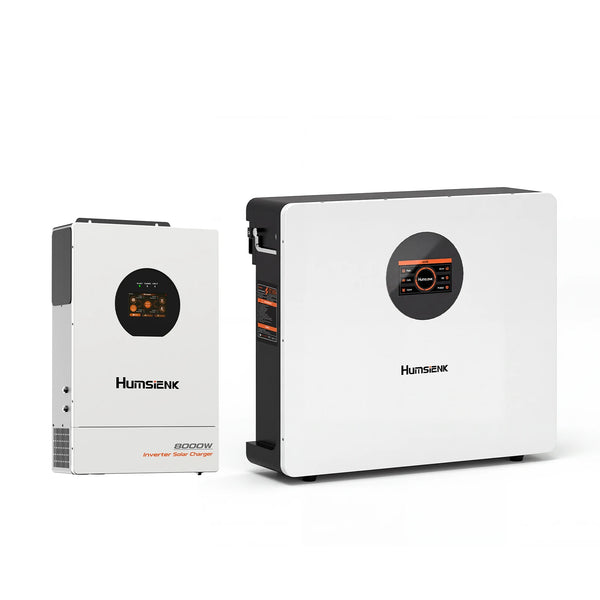
8kW Hybrid Inverter + 48V 100Ah LiFePO4 Battery
Why this combination works. The 8kW inverter's 160A charger is more current than a single 100Ah battery's 100A BMS can accept, so you're always charging as fast as that battery can go. For a household load in the hundreds, not thousands, of watts, that trade-off barely registers, and it means the household is not paying for charging capacity it does not need yet. If usage increases later, whether from a new appliance or simply wanting more hours of backup, a second 100Ah battery can be added in parallel without touching the inverter, and the setup stays just as compact as it was on day one.

Which System Works Best for Whole Home Backup?
Some homeowners want more than the essentials covered. They want a true whole house battery backup system, one that keeps the kitchen, the HVAC, the well pump, and everything else running like nothing happened.
This is where the math changes quickly, because several large appliances can run at the same time. A 3-ton central air conditioner commonly draws 2,400 to 3,500 running watts, with a startup surge that can briefly reach 6,000 to 9,000 watts. A 3/4 HP well pump typically runs at 1,000 to 1,500 watts, surging to 3,000 to 4,500 watts on startup. An electric oven adds 2,000 to 5,000 watts while heating, and the refrigerator and general lighting bring another 500 to 1,000 watts. If the air conditioner, well pump, and oven happen to run together, continuous load alone can approach 6,000 to 8,000 watts, before accounting for whichever motor happens to surge at that moment.
A load like this calls for speed as much as capacity, which is where the inverter's fast switching earns its keep: UPS transfer of 10 milliseconds or less means the switch from grid to battery happens before sensitive electronics reset, the refrigerator warms up, or a sump pump misses a cycle, and dual MPPT tracking, up to 10000W of solar input on the 8kW model or 12000W on the 12kw inverter, keeps the battery recharging through the day even during a longer outage. The battery has to keep pace with that kind of sustained, high-draw use, and both the Humsienk 300Ah and 314Ah LiFePO4 batteries are built for it: 15.36kWh and 16.1kWh, a 200A BMS, automotive-grade A+ cells rated for 6,000-plus cycles at 80% DOD (depth of discharge), steel casing, active balancing, and Bluetooth and LCD monitoring you can check the way you would check a thermostat. The 48V 300Ah wall-mounted LiFePO4 battery have 15.36kWh capacity energy and saves space while with less wiring, while the 314Ah floor-standing version suits a household that wants a dedicated equipment footprint instead. That is why, for moderate-sized homes, we pair the 8kW inverter with one 300Ah or 314Ah battery, and for larger homes with heavier simultaneous loads, step up to the 12kW inverter with two of those batteries in parallel.
Now visit the Humsienk 12kW inverter and 48V 300Ah 15.36kWh battery combination page. The 48V 12kW hybrid inverter and battery price is $3,299.99. Use the discount code READER6% at checkout to get a 6% discount on your order. After used the coupon code, the price is only $3,101.99. This is our way of expressing our gratitude for being a blog reader.
Which System Works Best for Commercial and Industrial Energy Storage?
Businesses and facilities have different priorities than homes. Load is often higher and less predictable, utility demand charges can be a real cost factor, and backup power during business hours is not optional.
Commercial load is harder to generalize than a home's, since it depends heavily on the type of business. A few common categories to account for: refrigeration units or walk-in coolers, HVAC rooftop units sized well beyond residential tonnage, task and display lighting, POS terminals and office computers, and any motors or equipment specific to the operation. Because these vary so widely, from a small retail space to a light manufacturing floor, the more reliable approach is to total the nameplate wattage of your major equipment, add the largest expected startup surge on top of your running total, and size the system from there rather than relying on a single generic figure.
A commercial site needs an inverter that scales in fixed steps rather than one you outgrow overnight. Up to six 12kW inverters can run in parallel for 72kW of combined output, and time-of-use charging lets a business shift to off-peak charging and draw down the battery during peak demand periods, cutting demand charges directly rather than just covering outages. RS485 and CAN ports let the system report into whatever energy management setup the facility already runs, and UL1741 and FCC Part 15 Class B certification covers the documentation most commercial installations require. The battery needs to scale the same way, and the Humsienk 314Ah 16.1kWh floor-standing LiFePO4 battery does: steel casing and a dedicated footprint suit a mechanical room, a 200A BMS per unit keeps charging fast, and support for up to 15 units in parallel means the bank can be sized to the site's actual load rather than a single fixed option. That is why we recommend multiple 12kW inverters in parallel, up to six units for 72kW combined, paired with as many 314Ah floor-standing batteries as the site's load calls for.
Now visit the Humsienk 12kW inverter and 48V 314Ah floor-standing LiFePO4 battery combination page. The 48V 12kW hybrid inverter and battery price is $3,599.99. After used the coupon code READER6% at checkout, the price is only $3,383.99.

Humsienk Home Energy Storage System
Parallel inverters and a parallel battery bank scale together rather than one becoming a bottleneck for the other, which matters for a facility that may add equipment or expand operations over time. And because the charging modes support genuine time-of-use scheduling rather than a simple on-off backup function, the same system that protects against outages also works daily to reduce demand charges, which is a meaningfully different value proposition than the backup-focused reasoning that applies to most residential energy storage systems.

Which System Should You Choose If You're Planning to Grow Later?
Not everyone is ready to commit to a full system right away. Maybe you just moved into a home and want to start small. Maybe you are testing solar for the first time. Maybe your business is scaling and you would rather add capacity as you go than overbuild now.
When you are not sure yet how far you will take this, the inverter's real value is in what it does not ask of you. The 8kW hybrid inverter runs as a single, uncomplicated unit with 21 safety protections built in from day one, and because it supports up to six units in parallel, today's purchase is a starting point rather than something you will replace later. The battery follows the same logic: the 48V 100Ah battery scales up to 15 units in parallel, so early growth just means adding batteries rather than swapping out what is already installed, and Bluetooth and LCD monitoring make it easy to watch how your usage develops over the first few months before deciding what to add next. That is why our starting recommendation is simple: the 8kW inverter with one wall-mounted 48V 100Ah battery (5.12kWh), a real system from day one, not a placeholder.
Because both the inverter and the battery are designed around parallel expansion rather than replacement, growth later means adding units, not starting over. Add more batteries in parallel to grow storage capacity, or add a second inverter in parallel if power needs eventually outgrow one unit. Either way, nothing bought today goes to waste later.
Quick Reference: Which Combination Matches Your Scenario?
|
Scenario |
Inverter |
Battery |
Total Capacity |
|
Small residential |
8kW |
1x 48V 100Ah |
5.12kWh |
|
Whole home backup |
8kW or 12kw inverter |
1x or 2x 300Ah/314Ah |
15.36 to 32kWh |
|
Full off-grid |
12kw inverter |
3 or 4x 314Ah |
48 to 64kWh+ |
|
Commercial/Industrial |
12kW (paralleled) |
Multiple 314Ah |
Scales per site |
|
Growing/phased |
8kW |
1x 48V battery, expandable |
5.12kWh+ |

What Other Question About Inverter and Battery?
Can You Mix Different Battery Models on the Same Inverter?
Batteries of the same voltage class can technically share an inverter, but we recommend matching models where possible. It keeps BMS communication consistent and makes monitoring simpler across the bank.
Q1: How Many Batteries Can You Add Later?
Our 48V batteries support up to 15 units in parallel, so there is a long runway for expansion without switching to a different product line.
Q2: Do You Need Two Inverters for a Large Home?
Not always, but for larger properties or commercial sites, our inverters support up to six units in parallel, which allows the system to scale well past what a single unit could provide.
Q3: Is the 12kw Inverter Too Much for a Small Home?
Running under-loaded will not damage the inverter, but for most smaller homes, the 8kW model is the more cost-effective fit. The 12kW unit tends to make more sense once you are covering a larger home, an off-grid property, or a commercial space.
Q4: How Do You Calculate Your Own Household's Load?
Check the nameplate on your major appliances for their rated wattage, add up what typically runs at the same time, and include the largest startup surge among them on top of that running total. The load estimates in each scenario above use common wattage ranges for that reason, as a starting point, but your own equipment's nameplate will always be more accurate than a general estimate.
Comments
-
Cuántos paneles se necesitan pars el inversor de 8kwh con la batería de 48v 100Ah
Leave a comment
Your email address will not be published. Required fields are marked *

 September 5, 2026
