

 September 3, 2026
Why Are You Still Running Two Batteries for One 24V System?
If you run a 24V truck, RV, or boat, chances are you have accepted something without ever really questioning it: one battery dedicated to starting the engine, and an entirely separate battery responsible for powering everything once the engine is off. Two batteries, two charging paths, two systems to maintain, and two potential points of failure.
This arrangement has been standard for decades, and it does function. But it also means more weight in the battery compartment, more wiring to troubleshoot, and less usable space for anything else. The real question is not whether this setup works. It is whether it remains the most sensible approach now that a single battery is capable of performing both roles of startup and power supply.
What Goes Wrong When You Run Two Separate Batteries?
A traditional starting battery is built to release a short, powerful burst of current and then get recharged almost immediately. A deep cycle or house battery is built for the opposite: a slow, steady draw over hours, sometimes days, without needing the engine running.
Put both into a 24V truck, RV, or marine setup, and you inherit the limitations of each. The starting battery cannot reliably support cab electronics, refrigeration, or onboard equipment for any meaningful length of time. The house battery, in turn, cannot deliver the current an engine requires to start, particularly in cold weather. So you end up carrying both, along with the extra wiring, isolators, and battery trays needed to keep them from interfering with each other.
There is also the fuel cost of the workaround. Many owners simply idle the engine to keep the house battery charged while parked, which burns fuel, adds engine hours, and wears down a system that was never meant to run that way.
Humsienk 24V 5.88kWh 1800CCA Dual Purpose Battery
This principle underpins the design of the Humsienk 24V 230Ah Dual Purpose LiFePO4 Battery. It was developed specifically for owners who have reasonably questioned why a 24V system should require two batteries to accomplish what a single, properly engineered battery can achieve. You don't need separate batteries for starting and daily power. One lithium battery can start your engine and keep your essential equipment running.
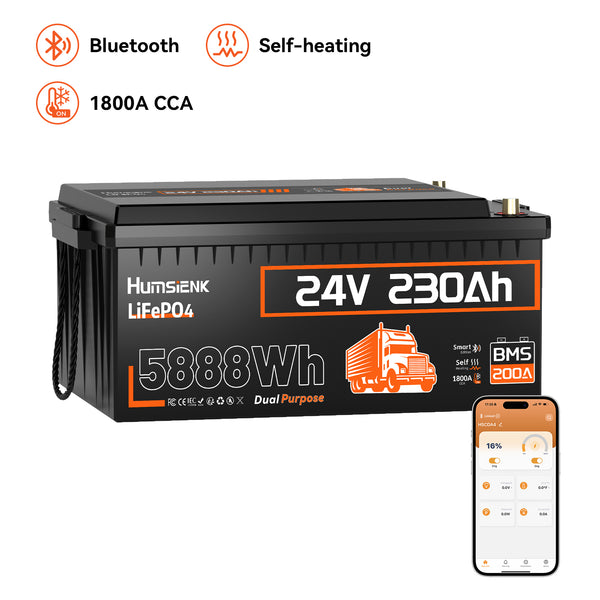
24V 230Ah 1800CCA Dual Purpose Battery ($1,199.99)
Key Takeaway
if you requires both dependable starting power and a genuine energy reserve once the engine has stopped, This Humsienk 5880Wh 1800CCA dual purpose battery is exactly your ideal choice. For owners whose use of a truck, RV, or vessel reflects that pattern, a dual purpose battery addresses a real operational need rather than introducing capability that goes unused.
Can One Battery Really Start a 24V Diesel Engine?
This is typically where reasonable doubt enters the conversation. A deep cycle battery, however well built, is not usually designed to deliver the sharp current required for a cold start in a diesel engine or marine motor.
The Humsienk 24V 230Ah battery is rated at 1800CCA (cold cranking amps), placing it firmly within the range expected of a dedicated 24V starting battery. The battery is engineered with sufficient starting current to turn over a heavy-duty diesel engine, a semi-truck power plant, or a marine engine, including in cold conditions, without requiring a separate starting battery on standby.
How Much Power Remains After the Engine Is Shut Off?
Starting the engine addresses only part of the requirement. The remaining question is what capability exists once the vehicle is parked, the vessel is anchored, or the engine has been stopped for the night.
With 230Ah of capacity and 5.88kWh of usable energy, this battery is sized closer to a dedicated 24V deep cycle battery than to a traditional starting battery. That reserve of usable energy supports an RV's appliances, a truck's cab electronics and auxiliary equipment, or a vessel's onboard systems well after the engine has gone quiet. A 200A BMS supports continuous high-load discharge with a maximum load of 5120W, allowing the battery to sustain genuine household style and equipment loads rather than light electronics alone.
Compared to a lead-acid battery, this also translates to more usable energy within a comparable footprint, since LiFePO4 chemistry does not require the conservative discharge limits that lead-acid batteries do. Rated for approximately 6,000 cycles at 80% DOD (depth of discharge), the battery is also built to withstand daily cycling rather than occasional backup duty.

Does This Battery Still Perform in Cold Weather?
Cold weather is where a lot of lithium batteries, and a lot of promises, start to fall apart. Charging LiFePO4 cells below freezing without adequate protection can cause lasting damage, which is a real concern for winter boating, cold-climate trucking, or RV travel that does not stop just because the temperature drops.
The Humsienk 24V 230Ah battery includes built in self-heating that activates automatically in low temperatures, allowing it to charge safely and perform consistently in cold conditions. For anyone running a lithium battery through winter months, that is not a bonus feature. It is what makes year-round use possible in the first place.
What Keeps This Battery Reliable Under Daily Use?
None of the preceding advantages hold meaning if the battery cannot be trusted to operate safely under daily conditions, whether installed in a truck cab, a marine engine bay, or an RV compartment subject to vibration and moisture.
The 200A BMS provides multi-stage protection against overcharge, over-discharge, over-current, short circuits, and high or low temperature conditions, supported by continuous monitoring. Bluetooth connectivity allows state of charge, voltage, current, temperature, and overall battery status to be checked directly from a smartphone, giving owners visibility into battery performance without needing to open a compartment or run a manual inspection. The IP65-rated enclosure provides further protection against moisture, dust, and corrosion, a requirement as relevant on a rain-soaked highway shoulder as it is on open water.
They are what allow the dual purpose function to be trusted for both starting and daily energy use, day after day.
Will This Battery Fit and Charge Like Your Current Setup?
This is usually the real deciding factor, more than any spec sheet. Before switching to a single dual purpose battery, most owners want a straight answer to three questions.
Can your existing alternator or charging system charge it? LiFePO4 batteries accept charge differently than lead-acid, but a 24V charging system built for standard charging voltages can typically charge this battery without needing to be replaced. It is still worth confirming your specific alternator or charger's output against the battery's charging specifications before installing.

Do you need additional charging equipment? In most 24V truck, RV, or marine setups, no separate charge controller is required for basic charging. If your system already includes solar input or shore power charging, those paths generally work the same way they would with your current battery.
Will it physically fit your battery compartment? At 20.63 x 14.37 x 9.15 inches and 95.35 lb, it is worth measuring your existing compartment against these dimensions before ordering, particularly if you are replacing two batteries with one and reconfiguring the space.
Where Does a 24V Dual Purpose Battery Make the Most Sense?
Heavy-duty trucks and semi-trucks. Start the engine each morning, then power cab electronics, auxiliary equipment, or sleeper cab systems during rest periods, without idling the engine solely to maintain a charge.
RVs and motor homes. Start the vehicle, then supply lighting, appliances, and onboard systems while parked at a campsite or operating off-grid, without depleting a separate house battery or depending on a generator.
Marine and boat. Start the motor, then power navigation electronics, lighting, and onboard equipment while anchored, with confidence that sufficient reserve remains to start the engine again when needed.
Across each application, the pattern remains consistent: strong starting current while the engine runs, and dependable stored energy once it does not, with meaningfully less unnecessary idling required to maintain a separate battery.
Comments
No comments yet.
Leave a comment
Your email address will not be published. Required fields are marked *

 September 5, 2026
